
The syllabus designed by the Central Board of Secondary Education (CBSE) for Classes 9 to 12 plays a vital role in building a student’s academic foundation and shaping future career paths. This phase is not limited to textbook learning—it focuses on understanding concepts, developing skills, and preparing students for real-world challenges.
This article provides a complete overview of subjects, streams, assessment patterns, and preparation strategies for CBSE Classes IX to XII.
May be you need: Download CBSE Syllabus 2026-27
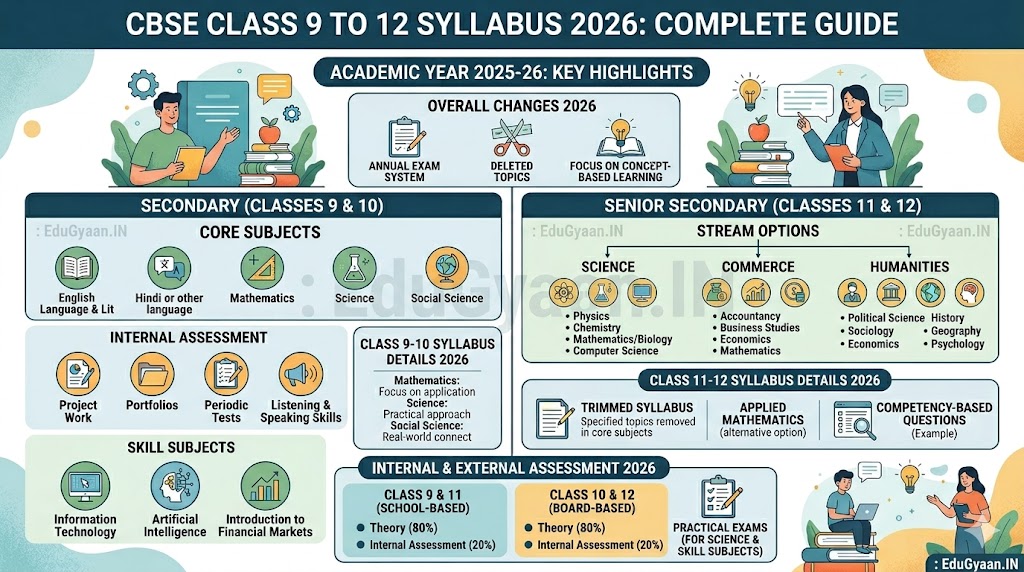
Secondary Stage (Class 9–10): Building Strong Basics
Classes 9 and 10 are considered the foundation stage of school education. The focus here is on strengthening basic concepts that will be used in higher classes.
Core Subjects:
Languages (English / Hindi)
Mathematics
Science
Social Science
Computer Applications / Skill Subjects
Key Focus Areas:
Students should concentrate on understanding concepts rather than memorizing. Subjects like Mathematics and Science require regular practice, while Social Science and Languages demand good writing skills.
Assessment Pattern:
Class 10 includes a board examination along with internal assessments such as periodic tests, projects, and notebook work.
Senior Secondary Stage (Class 11–12): Choosing Your Career Path
At this stage, students select a stream based on their interests and career goals. This decision significantly influences their future academic and professional journey.
Science Stream
Subjects generally include Physics, Chemistry, and either Mathematics or Biology. Students may also opt for Computer Science or Physical Education.
This stream focuses on analytical thinking, numerical problem-solving, and practical learning through laboratory work. It is suitable for careers in engineering, medicine, and research.
Commerce Stream
Commerce students study Accountancy, Business Studies, and Economics, along with optional subjects like Mathematics or Informatics Practices.
This stream emphasizes logical understanding, financial concepts, and real-life business applications. It is ideal for careers in finance, management, and commerce-related fields.
Humanities (Arts) Stream
Humanities includes subjects such as History, Political Science, Geography, Sociology, and Psychology. This stream develops critical thinking, analytical writing, and awareness of society and current affairs. It is suitable for careers in civil services, law, teaching, and social sciences.
Skill-Based and Vocational Subjects
CBSE has introduced skill-based subjects to make education more practical and career-oriented.
Popular options include Artificial Intelligence, Information Technology, Marketing, Healthcare, Financial Literacy, and Entrepreneurship.
These subjects help students develop real-world skills and improve employability.
Evaluation System
For Classes 9 and 10, students are evaluated through a combination of written exams and internal assessments. For Classes 11 and 12, evaluation includes theory exams, practical exams, project work, and viva in selected subjects. The system ensures continuous learning and overall development.
Smart Preparation Strategy
Students should rely primarily on NCERT textbooks as they form the base of CBSE exams.
Regular revision, solving previous year question papers, and maintaining a proper study schedule are essential. A balanced plan with daily study and weekly revision helps improve performance and confidence.
Common Mistakes to Avoid
Many students depend only on guidebooks and ignore NCERT, which can lead to weak conceptual understanding.
Lack of revision, poor time management, and last-minute preparation are also common issues that should be avoided.
Consistent practice and discipline are key to success.
Conclusion
The CBSE syllabus from Classes 9 to 12 is designed to prepare students not only for examinations but also for their future careers. With the right approach, consistent effort, and clear understanding of concepts, students can achieve excellent results and build a strong academic foundation.



Comments
Join the discussion
Register as a user and comment
Keep your learner identity with your comments and access your EduGyaan profile.
Comment as guest